
The Tree That Holds a Lesson About Wealth Every American Family Should Hear.
By Mike Neubauer, Grand Vision Family Office
April 20th, 2026 | 8 Min. Read
Your Grandfather Had Something You Don't.
Not wisdom.
Not a work ethic.
Not some mythical "greatest generation" grit.
Something far more practical.
He had an orchard.
But not just any orchard…
He had a money tree orchard.
He didn't plant it. He didn't own it. He didn't manage it.
He just walked out there every month of his retirement and collected the fruit from it.
A check showed up. Same day. Same amount. For as long as he lived.
He didn't have to “time” the market.
He didn't have to calculate a "safe withdrawal rate."
He didn't have to sit across from an advisor twice a year staring at a spreadsheet wondering if he had enough.
The orchard produced. He ate.
Then, sometime between his life and yours, the orchard disappeared.
Not with a bang. Not with a headline. It just quietly went away.
And in its place, somebody handed your father a basket.
My goal with this article is simple.
I want to show you the difference between an apple basket and an apple orchard - and why understanding that difference is the single most powerful financial shift you could ever make.
A shift that will make you far wealthier than the person picking apples next to you.
And one that, almost by accident, leaves behind a legacy your great-grandchildren will still be eating from long after you are gone.
Stick with me. This one matters.
The Tree in My Backyard
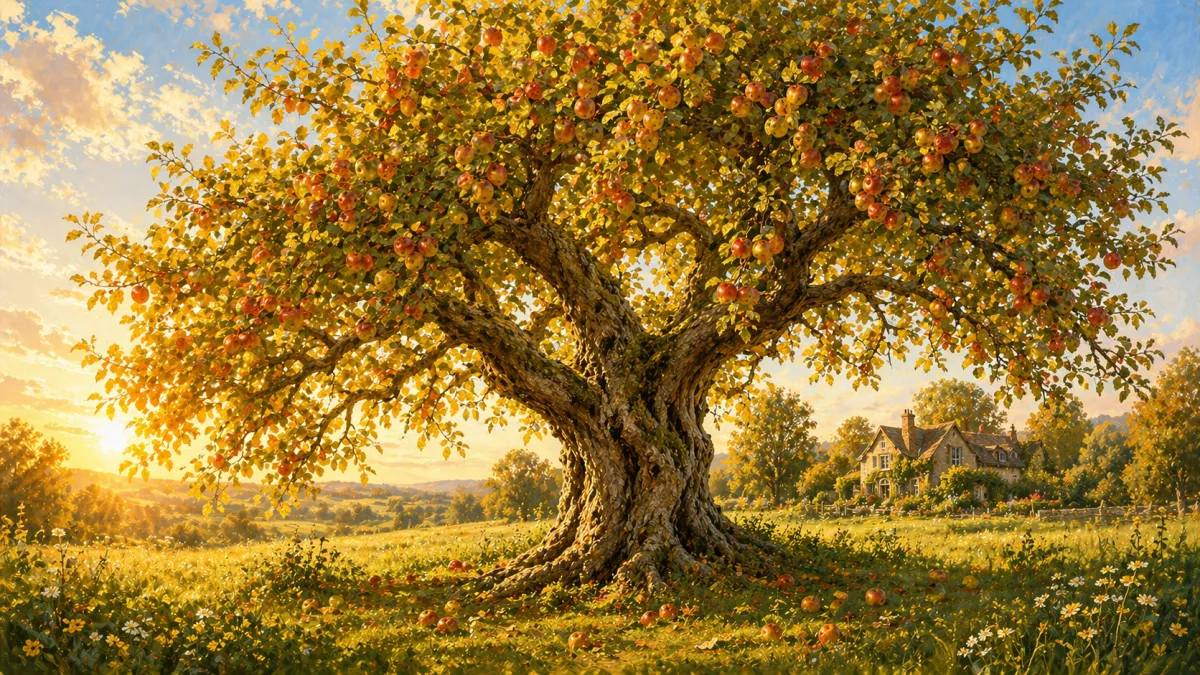
I live on a small 40-acre farm in Crown Point, Indiana.
We are the third family to live on this land.
About 80 years ago, long before my wife and I ever walked the property line, the first family here decided to plant an apple orchard out behind the house.
Most of those trees are gone now. Time took them, the way time eventually takes most things.
But one tree is still standing.
And that one tree has taught me more about wealth - and about life - than any book I have ever read.
When September rolls around each year, my kids race out to that old tree.
They climb it like it was built for climbing - up into the branches, straight to the top, right where the best apples hang. They come running back to the house with their shirts pulled up in front of them, full of fruit, sticky and proud of the haul.
On quiet fall mornings, I sit on the back porch with a cup of coffee and watch a few deer wander out of the tree line to the fallen apples underneath that same tree. They take their time. They eat what the kids didn't get to. And when they've had enough, they slip back into the woods the same way they came.
That tree has no idea who owns this farm.
It does not know that the family who planted it has been gone for generations.
It does not care whether the economy is good or bad, whether the stock market is up or down, whether there is a war in the Middle East or a new president in the White House.
It just produces fruit.
Year after year after year.
A 35-year-old farmer made a single decision 80 years ago.
He dug a hole. He planted a tree. He watered it for a few seasons.
And today - long after he is gone, long after his children are gone, after the land changed hands twice - his tree is still feeding people. My kids. The deer. Anyone who walks past.
That tree is the basis of my entire investment philosophy.
I am not trying to collect the biggest basket of apples before I die.
I am planting an orchard that will still be feeding my great-grandchildren 80 years from now.
The Shift Nobody Noticed
Here is what happened.
When your grandpa’s orchard disappeared, the message to working Americans was simple.
"Go collect as many apples as you can."
Most people did not stop to think about it. They looked around, saw a basket, and started filling it.
That is what everyone else was doing. That is what the neighbors were doing. That is what their boss was doing.
Fill the basket. Fill it faster. Fill it bigger.
And the baskets got bigger.
Charts started appearing in magazines showing how to fill a basket more efficiently.
Brokers started selling bigger and bigger baskets.
Financial advisors built entire careers around helping people pack their apples tighter.
An entire industry grew up - not to plant trees, but to optimize the picking.
Nobody ever stopped to ask the most obvious question.
What if the point was never to collect apples at all?
Because here’s the thing…
The financial industry did not make a mistake. It saw an opportunity.
Because when millions of people are scared of running out of apples, there is an enormous amount of money to be made by being the person who manages their basket.
And so an industry was built. A massive one.
Advisors to help you pick.
Brokerages to sell you bigger baskets.
Mutual funds to diversify your apples.
Calculators to tell you how fast you can eat from the pile without running out.
Every one of them solving the same problem in the same way. None of them asking the better question.
And here is the part that nobody says out loud…
The basket pays the advisors.
The basket pays the brokers.
The basket pays the industry.
But a tree…
A tree pays you.
And that is why no one has ever shown you how to plant one.
The Other Problem With the Basket
The industry isn't even the worst part.
The basket is doing something to you that no advisor, no broker, no calculator ever will admit.
When you live your financial life as an apple picker, you live under a very specific kind of fear.
You never want to eat any apples today.
Every apple in your basket is one you might need in the future. Every apple you eat now is one less apple when you are 80.
So you save.
You scrimp.
You delay.
You tell yourself you will enjoy it later.
You work through your 30s because you are trying to fill the basket.
You work through your 40s because the basket still isn't big enough.
You work through your 50s because the calculator keeps telling you that you need just a little bit more.
And then you hit your 60s, and for the first time in your adult life, you are supposed to stop picking and start eating.
Stop the habit you built over 40 years. Reverse it. Eat from the pile instead of adding to it.
And every single meal you eat reduces the pile.
This is not freedom. This is a different kind of fear.
The picker spends their working life concerned that the basket is not big enough.
Then the picker spends their retirement concerned that the basket may run out.
The basket model delivers anxiety at both ends.
And the worst part?
No matter how big the basket gets - even if it is the biggest basket you have ever seen - one day you die, and whatever is left in it is divided among your heirs and eaten within a generation or two.
That is the math.
The biggest basket in the world still gets eaten eventually.
What Apple Picker Mentality Is Actually Costing You
Let me bring this down to your week.
Because this is where it gets uncomfortable.
You work five days a week.
Monday, Tuesday, Wednesday, Thursday, Friday.
That is your week. Each day represents 20 percent of the hours you put in.
Now look at where those hours actually go.
For most successful Americans, roughly 35 percent of every dollar earned disappears to taxes before it ever hits your bank account.
Federal income tax.
State income tax.
Medicare.
Social Security.
Think about what that means.
All day Monday...
Every single hour you work...
Is for the tax man.
By the time you finish lunch on Tuesday,
you have now earned enough to pay your tax bill for the week - and not a dollar more.
Read that again.
Almost a day and a half of every single work week is spent earning money you will never see.
It never touches your bank account. It never goes into the basket. It never plants a tree.
Tuesday afternoon through Wednesday, you work to pay for your house.
The mortgage. Property taxes. Insurance. Utilities.
Thursday and most of Friday, you work to fund your life.
Groceries. Gas. Kids' activities. Debt payments. The basic cost of being alive in America.
And then there is Friday afternoon. That last thin sliver of the week.
That is the only part of your paycheck that is actually yours.
That is the only part that goes into the basket.
Everything else - 90-plus percent of the hours you worked this week - went to keeping the lights on.
Now here is the question nobody is asking.
What if, instead of spending that Friday sliver stuffing one more apple into a basket, you spent it planting a tree?
A tree that produced income on its own.
A tree that, year after year, covered part of your tax bill.
A tree that covered part of your house.
A tree that covered part of your life.
What if you planted enough trees that Monday was no longer the tax man's day - because your orchard was paying him for you?
What if the orchard bought back Tuesday too? Then Wednesday?
Because here is what almost nobody will ever tell you.
You do not need to replace your salary to retire.
You simply need enough cash flow to cover your expenses.
Your salary needs to be big because it has to pay for the work of earning a salary.
Taxes on every dollar.
The commute.
The wardrobe.
The lunches.
The stress.
The savings you have to set aside to fill the basket.
All of that disappears the moment you stop working for your money.
The number you actually need to cover is much smaller than most people think.
And it is a cash-flow number, not a basket number.
An orchard can cover it.
A basket cannot.
Retirement Is Not a Year. It Is an Orchard.
Most people have been taught that retirement is an age - 65. 67. 70.
A year on a calendar when you stop collecting apples and start pulling from your basket.
That is not retirement. That is the end of the picker's life.
Retirement is not a year.
It is not an age.
It is not a finish line on a calendar.
Retirement is simply the day your orchard covers your life.
And once you see retirement that way, something remarkable happens.
It stops being a date and starts being a state.
A state that can arrive at 40 if you plant early enough.
A state that can arrive at 55.
A state that even arrives, for some people, before they're ready to stop working.
The key point is...
It's a state that arrives on a timeline that you control.
And the beautiful thing about an orchard is that it does not wait for a birthday.
Your orchard starts growing the day you plant your first tree.
At 40, your orchard might be buying back one day a week for you. You work four days instead of five because the orchard is handling the fifth.
At 50, your orchard may be covering enough that the word "retirement" becomes real. You work because you want to, not because you have to.
At 68, your orchard is paying for the six-week road trip to see your grandkids - without touching a single account, without "drawing down" anything. The orchard just produces, and you just go.
At 90, when you need home health assistance, the orchard is still producing. Nobody is running math on whether your basket will hold out. The trees keep bearing fruit.
And long after you are gone - long after your kids are gone, long after anyone remembers the details of your life - somebody's great-grandchild will walk past a tree you planted and pick an apple off the top.
Just like my kids do in my backyard.
That is the difference between a basket and an orchard.
That is the difference between apple picking and planting trees.
That is the difference between an end and a legacy.
"So What Exactly Do You Do?"
I get asked this question all the time.
"You run a family office. What does that actually mean...
Are you like a financial advisor? A wealth manager? An investment firm?"
People are trying to compare a family office to something they already understand.
And I get it. The mind wants to put things into familiar boxes.
But every one of those comparisons is trying to line us up next to the apple pickers.
Financial advisors, wealth managers, investment firms - they are all in the same business.
They are in the business of helping you fill a bigger basket.
Pick the right stocks.
Pick the right funds.
Pick the right withdrawal rate.
Pick, pick, pick.
That is not what we do.
We do not pick apples. We do not manage baskets.
We do not tell you "here is the number you need to retire at 65."
We plant money trees.
A money tree might be a rental property.
It might be a private note.
It might be a business distribution.
It might be a dozen other strategic investments.
Whatever it is, it has one thing in common: it produces year after year - whether you show up or not.
We look at your life and we say:
"Here is how much of your work week is spent just paying the tax man. Let's start planting trees to buy back your Monday. Here is how to do it."
Then we do the same thing for Tuesday. Then Wednesday.
One tree at a time. One day bought back at a time.
Our members still watch their net worth grow, because a healthy orchard naturally builds wealth.
But that is not how they measure whether they are winning.
They don't count how many apples are in the basket.
They count how much of their life the orchard is already paying for - and they watch that number grow year after year, one tree at a time.
That is what a family office does.
At least, that is what ours does.
The One Thing to Remember
If you take nothing else from this article, take this.
Your grandfather had an orchard that somebody else planted - they called it a pension.
Somewhere along the way, that orchard disappeared - and nobody told you how to plant your own.
The people who figured it out have spent the last few decades quietly planting trees while everyone else was filling baskets.
The orchard your grandfather had is gone. But the ability to plant one of your own is still very much here.
It is not reserved for the ultra-wealthy or some special class of people with access you don't have.
It is there for anyone willing to stop picking long enough to plant.
The financial industry has spent decades convincing you that the basket is the only game in town.
It is not.
An orchard does not care whether the market is up or down. It does not care what interest rates are. It does not care if you are 40 or 68 or 90 years old.
It just produces.
And the decision to plant one does not happen at retirement age.
It happens now.
Just like that 35-year-old farmer, 80 years ago, standing in what is now my backyard…
He dug a hole, dropped in a seed, and covered it with soil.
One decision to plant a tree...
So that now, generations later, on a crisp September morning…
A father he would never meet could stand on a back porch and feel the quiet joy of watching his own children climb it.
Eighty years from now, someone is going to stand on a porch somewhere and reap the fruit of a decision you made today.
Or they won't.
Stop filling your basket.
Start planting your family’s orchard.
-Mike Neubauer
Founding Member, Grand Vision Family Office
P.S. If you’d like to learn more about me, and
why I take the time to write these articles,
I shared a bit more on this page.
THIS IS NOT PERSONAL FINANCIAL ADVICE:
Because common sense isn't always 'common', here is the legal disclosure: This article is for informational purposes only and does not constitute financial, investment, tax, or legal advice. Grand Vision Family Office does not guarantee the accuracy or completeness of the information provided. All investments involve risk, including potential loss of principal. Readers should conduct their own research and consult with a professional advisor before making any financial decisions. For full disclaimers, visit https://grandvision.co/family-office/disclaimers.
Copyright 2026 © Grand Vision Companies. All Rights Reserved.
Disclaimer: This website is for informational purposes only and not for reliance in evaluating the merits of investing in the Fund. No regulatory authority has approved or assessed the accuracy or completeness of this information. Prospective investors must rely on their own examination and consult professional financial, legal, and tax advisors. The Fund and sale of Interests are not registered, and registration is neither anticipated nor required. Only "accredited investors" may purchase Interests, and they must be prepared to bear economic risk indefinitely. Reselling Interests is restricted, and no public market exists for them. The General Partner does not provide investment recommendations or advice. Contents of this website are proprietary, confidential, and trade secret. Unauthorized reproduction, distribution, or use of its contents are prohibited. Forward-looking statements are inherently unreliable and subject to numerous risks and uncertainties. Investing in the Fund involves significant risks, including economic recession, market volatility, competition, legislative/regulatory changes, key personnel retention, acquisition/development challenges, financial condition of partners, tax status maintenance, and potential uninsured losses or environmental liabilities. Please review the "Risk Factors" section in the Fund's offering documents for a comprehensive understanding of risks. The General Partner assumes no obligation to update or revise statements based on new information, future events, or otherwise.